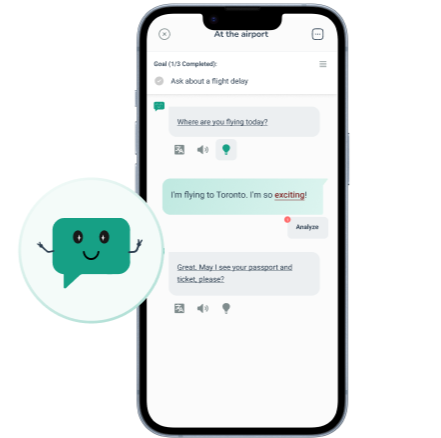
Download LingUp to continue the roleplay and get instant feedback on your grammar and pronunciation.
Try LingUp Now!Begin with the 'key' part: Start with a long 'ee' sound.
Move to the 'board' part: Start with a 'b' sound, then add the 'or' as in 'or', and end with a 'd'.
Stress the first syllable: KEY-board.
kee-bored (wrong vowel sound in the second syllable)
ki-board (short i instead of long e)
kee-boared (extra syllable added)
Begin with the 'key' part: Start with a long 'ee' sound.
Move to the 'board' part: Start with a 'b' sound, then add 'ɔː' for the 'or' and end with a 'd'.
Stress the first syllable: KEY-board.
kee-bod (incorrect vowel in the second syllable)
ki-board (short i instead of long e)
kee-boared (extra syllable added)
The vowel sounds are different. Use the 'or' sound, not the 'o' from 'bored'.
Stress the first syllable: KEY-board.
English words often end with a clearer final consonant, like the 'd' in 'board'.
A device with keys used to type on a computer.
/kiː/
A small piece of shaped metal to open locks.
/bɔːrd/
A flat piece of wood or material.
/ˈtaɪpˌraɪtər/
A machine for writing mechanically.
'Key' has only one syllable, 'keyboard' has two.
Stress in 'keyboard' falls on the first syllable, unlike 'board'.
'Keyboard' uses a longer vowel in 'key' compared to 'typewriter'.
Compare 'keyboard' with 'keychain' and 'keyhole' for stress and vowel sound.
Record yourself and listen to improve your pronunciation of 'keyboard'.