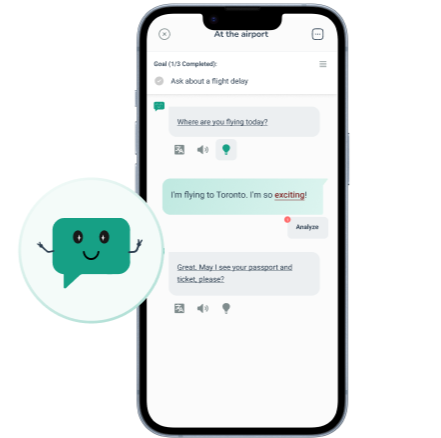
Download LingUp to continue the roleplay and get instant feedback on your grammar and pronunciation.
Try LingUp Now!Step 1 for AmE: Start with the strong 'v' sound by placing your top teeth on your bottom lip.
Step 2 for AmE: Follow with the short 'i' sound like in 'sit', keeping it brief.
Step 3 for AmE: Finish with the soft 'zit' sound, emphasizing the soft 't'.
Adding an extra syllable vis-i-it
Pronouncing the 't' too strongly vi-zit
Stress on the wrong syllable vi-SIT
Step 1 for BrE: Begin with a voiced 'v', just as in AmE, with teeth on lip.
Step 2 for BrE: Use the short 'i' sound, similar to 'bit', softly and quickly.
Step 3 for BrE: End with a 'zit' sound and a lighter 't'.
Omitting the 'z' sound vi-it
Over-pronouncing the 'v' sound v-v-visit
Stress falling on the second syllable vi-SIT
Non-native speakers sometimes struggle with placing the teeth on the lip correctly.
The stress is on the first syllable: VIS-it.
Yes, but softly, especially in British English.
A trip to a place for a specific reason.
/ˈvɪzɪtər/
A person who visits.
/ˌvɪzɪˈteɪʃən/
The act of visiting.
/ˈvɪzɪtɪŋ/
The practice of visiting.
Different ending in 'visitor' with an extra syllable.
Longer middle sound in 'visitation'.
Gerund form 'visiting' with additional 'ɪŋ' sound.
Practice with words starting with 'v' to get used to the teeth on lip placement.
Practice by incorporating 'visit' into easy, short sentences to build confidence.
Test Your Pronunciation On Words That Have Sound Similarities With Visit