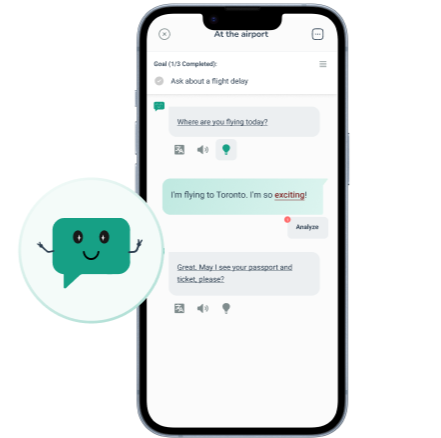
Download LingUp to continue the roleplay and get instant feedback on your grammar and pronunciation.
Try LingUp Now!Start with a relaxed 'buh' sound (/bə/). Your mouth is neutral.
Move to the stressed syllable '-lief'. Touch your tongue tip behind your top teeth for the /l/ sound.
Make a long 'ee' sound (/iː/), like in the word 'see'. Your lips should be slightly spread.
End with an /f/ sound. Touch your top teeth to your bottom lip and push air out without vibrating your throat.
Pronouncing the first syllable as 'bee' instead of 'buh'. (bee-lief)
Using a short 'i' sound, like in 'sit', for the second syllable. (be-lif)
Pronouncing the final 'f' sound as a 'v' sound. (be-liev)
same as American
same as American
The stress is on the second syllable: be-LIEF. Say the '-lief' part louder and longer than the 'be-' part.
No, it is a short, unstressed sound called a schwa: /bə/. It sounds like 'buh'. Your mouth should be very relaxed.
'Belief' ends with a voiceless /f/ sound (no throat vibration). 'Believe' ends with a voiced /v/ sound (your throat vibrates).
An idea that you are certain is true.
/bəˈliːv/
To think that something is true.
/bəˈliːvəbl/
Something that seems possible or true.
/ˌʌnbəˈliːvəbl/
Very surprising or hard to accept as true.
- 'Belief' ends in a voiceless /f/ sound, while 'believe' ends in a voiced /v/ sound.
- 'Belief' has two syllables (be-lief), while 'believable' has four (be-liev-a-ble).
- 'Unbelievable' adds the prefix 'un-' and has five syllables (un-be-liev-a-ble).
To practice the final sound, touch your throat. Say 'belief' - you should feel no vibration on the final /f/. Say 'believe' - you should feel a vibration on the final /v/.
Clap your hands on the stressed syllable. Say 'be-LIEF' and clap on 'LIEF'. This helps you remember where the emphasis goes.
Test Your Pronunciation On Words That Have Sound Similarities With Belief