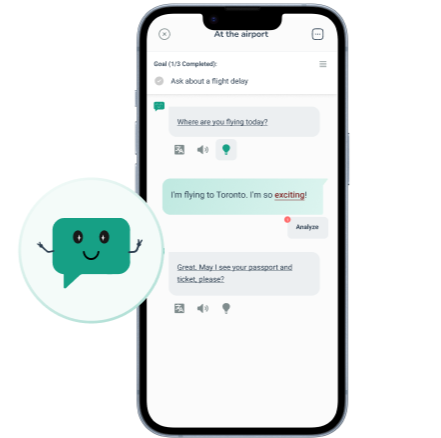
Download LingUp to continue the roleplay and get instant feedback on your grammar and pronunciation.
Try LingUp Now!Start with the first syllable 'dis'. Make a short /dɪ/ sound, like in the word 'did'. Finish with an /s/ sound.
For the second syllable 'prove', press your lips together for the /p/ sound.
Combine the /r/ with a long 'oo' sound /uː/, like in 'food'. End with a /v/ sound by touching your top teeth to your bottom lip and vibrating.
Pronouncing 'dis' with a long 'ee' sound (dees-prove). The 'i' is short.
Saying 'dis-proob' instead of 'dis-prove'. The final sound is a /v/, not a /b/.
Dropping the /r/ sound (dis-poov). Make sure to blend the /p/ and /r/ sounds together.
same as American
same as American
The stress is on the second syllable: dis-PROVE. Say the second part louder and longer.
It is a short 'i' sound, /ɪ/. It sounds like the 'i' in 'sit' or 'is'.
Gently place your top teeth on your bottom lip. Push air out and vibrate your vocal cords. It should feel like a buzzing sound on your lip.
To show that something is not true.
/dɪsˈpruːf/
Information that shows something is false.
/pruːv/
To show that something is true.
/ˈpruːvən/
Shown to be true or real.
'disprove' ends with a voiced /v/ sound, but 'disproof' ends with a voiceless /f/ sound.
'disprove' has stress on the second syllable (dis-PROVE), while 'proven' has stress on the first syllable (PRO-ven).
'disprove' and 'prove' have the same vowel sound and ending, but 'disprove' adds the 'dis-' prefix.
To distinguish between /v/ (disprove) and /f/ (disproof), place your fingers on your throat. You will feel a vibration for /v/ but not for /f/.
In many two-syllable verbs like 'disprove', 'reject', or 'confirm', the stress is on the second syllable, which carries the main action.