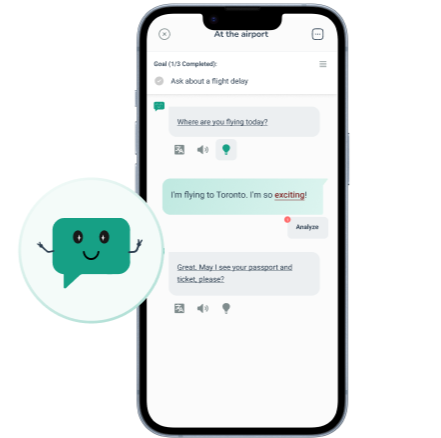
Download LingUp to continue the roleplay and get instant feedback on your grammar and pronunciation.
Try LingUp Now!Start with 'DU'. Make a 'd' sound, then a long 'oo' sound like in 'food'. Your lips should be rounded.
Add the middle syllable 'bi'. This is a short 'i' sound, like in the word 'sit'.
End with 'ous'. This sounds like the word 'us'. It is a short, relaxed sound.
Pronouncing 'du' with a short 'uh' sound (duh-bi-ous) instead of a long 'oo' sound.
Stressing the second syllable (du-BI-ous) instead of the first syllable.
Making the 'ous' ending sound like 'ohs' (du-bi-ohs).
Start with 'DJU'. Make a /dʒ/ sound, like the 'j' in 'judge'. Follow it with a long 'oo' sound like in 'food'.
Add the middle syllable 'bi'. This is a short 'i' sound, like in the word 'sit'.
End with 'ous'. This sounds like the word 'us'. It is a short, relaxed sound.
Using a simple 'd' sound at the beginning, which sounds American.
Stressing the second syllable (dju-BI-ous) instead of the first syllable.
Making the 'ous' ending sound like 'ohs' (dju-bi-ohs).
There are three syllables: DU-bi-ous.
No, the stress is on the first syllable. Say it like this: DU-bi-ous.
The main difference is the first sound. Americans say 'doo' (/duː/). British speakers say 'djoo' (/dʒuː/), like the start of the word 'juice'.
Feeling doubt or not sure if something is true or good.
/daʊt/
A feeling of being uncertain
/ˈdaʊt.fəl/
Feeling uncertain or full of doubt
/ʌnˈdaʊ.tɪd.li/
Without any doubt; certainly
- 'Dubious' starts with a 'doo' sound, but 'doubt' has an 'ow' sound like in 'cow'.
- 'Dubious' has three syllables (DU-bi-ous), while 'doubtful' has two (DOUBT-ful).
- The stress in 'dubious' is on the first syllable, but in 'undoubtedly' it is on the second syllable (un-DOUBT-ed-ly).
The most important part is to stress the first syllable: DU-bi-ous. This will make you sound more natural.
The ending '-ous' is common in English adjectives (like famous, serious). It is almost always unstressed and sounds like 'us'.