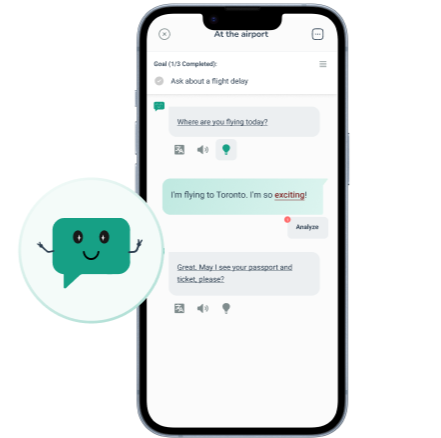
Download LingUp to continue the roleplay and get instant feedback on your grammar and pronunciation.
Try LingUp Now!Start with a soft 'uh' sound /ə/, like the 'a' in 'about'.
For the second syllable, 'blige', start with a 'bl' blend.
The vowel is a long 'i' sound /aɪ/, like in the word 'ice'.
End with a 'j' sound /dʒ/, like the 'g' in 'age'.
Pronouncing the first 'o' as 'oh' (oh-blige) instead of 'uh' (ə-blige).
Using a short 'i' sound (blig) like in 'big', instead of a long 'i' (blige).
Ending with a 'sh' sound (o-blishe) instead of a 'j' sound (o-blige).
same as American
same as American
'Oblige' has two syllables: o-blige.
The stress is on the second syllable: o-BLIGE.
The 'ge' sounds like the letter 'J'. Your tongue touches the roof of your mouth behind your teeth, then releases with a voiced sound, /dʒ/.
To do something for someone because it is your duty or because you want to help.
/ˌɑːbləˈɡeɪʃn/
Something you must do.
/əˈblɪɡətɔːri/
Required by a rule or law.
/əˈblaɪdʒɪŋ/
Willing and happy to help.
In 'obligation', the stress moves to the third syllable ('ga') and the 'i' sound is different.
In 'obligatory', the stress moves to the second syllable ('bli') and the vowel sounds change.
In 'obliging', the final sound changes from /dʒ/ to /ɪŋ/.
Always emphasize the second part of the word: o-BLIGE. This is the most important part of the pronunciation.
The 'ge' ending sounds exactly like the letter 'J'. Practice words like 'age', 'page', and 'huge' to master this sound.
Test Your Pronunciation On Words That Have Sound Similarities With Oblige