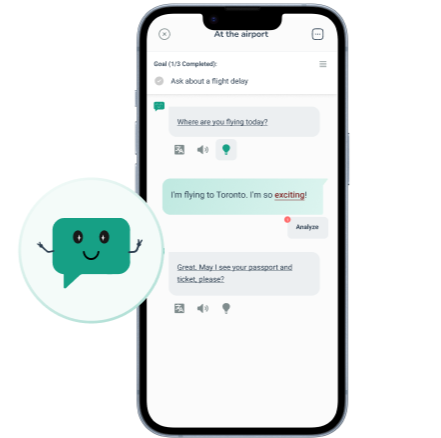
Download LingUp to continue the roleplay and get instant feedback on your grammar and pronunciation.
Try LingUp Now!Start with 'PRIV'. Your lips press for 'p', then pull back for 'r'. The vowel is a short 'i' as in 'sit'. End with 'v' by touching your top teeth to your bottom lip.
The second syllable is 'ledge'. Touch your tongue tip behind your top teeth for 'l'. The vowel is again a short 'i' as in 'sit'.
End with the 'dge' sound /dʒ/. This is the same sound as the 'j' in 'jump'. Your tongue touches the roof of your mouth and releases.
Pronouncing it with three full syllables (pri-vi-ledge). The middle vowel is usually dropped.
Using a long 'ee' sound in the first syllable (PREE-vledge).
Saying 'ch' instead of 'j' at the end (priv-lich).
Start with 'PRIV'. This is the same as American: 'p-r' followed by a short 'i' vowel as in 'sit', and a 'v' sound.
Add a very short middle syllable 'i'. This is a weak, unstressed vowel sound, like the 'i' in 'animal'.
End with 'lidge'. This is the same as the American ending: an 'l' sound, a short 'i' vowel, and the /dʒ/ sound as in 'judge'.
Stressing the second syllable (pri-VIL-idge). The stress is always on the first syllable.
Making the middle 'i' a long 'ee' sound (priv-EE-lidge).
Using a simple 'g' sound at the end instead of the /dʒ/ sound.
It can be two or three. In American English, it's often two: PRIV-ledge. In British English, it's often three: PRIV-i-ledge. The first syllable is always stressed.
It is the /dʒ/ sound. It sounds like the letter 'J' in 'jeans' or 'judge'. Your tongue touches the roof of your mouth, stops the air, and then releases it with your voice.
It is a short 'i' sound, like in 'sit' or 'big'. Say 'PRIV', not 'PRIVE'.
A special right or advantage that only one person or a small group of people has.
/ˈprɪv.lɪdʒd/
Having a special advantage.
/ˈprɪv.lɪdʒ/
To give a special advantage to someone.
/ˈprɪv.i/
Sharing knowledge of something secret.
Compared to 'privileged', 'privilege' does not have the final 'd' sound.
The verb 'privilege' is pronounced exactly the same as the noun.
'Privy' is shorter (PRIV-ee) and ends with a long 'ee' sound, unlike 'privilege'.
To sound more natural, especially in American English, try saying 'privilege' with two syllables: 'PRIV-ledge'. The middle vowel often disappears in fast speech.
Always put the emphasis on the first syllable: 'PRIV-i-ledge'. Never stress the middle part. Correct stress is very important for being understood.
Test Your Pronunciation On Words That Have Sound Similarities With Privilege